A Guide to Your Soil Functionality Analysis Report
A Soil Functionality Analysis report shows much more than nutrient levels. It shows how well your soil is actually working for your farm.



Your farm’s soil contains carbon, nutrients, bacteria, and fungi. And, your farm’s productivity depends on each of these things. But are those resources actually working for your bottom line? One key that helps answer this question is soil respiration, which provides an important clue about how effectively your soil can cycle nutrients to your crop.
Just like you, the organisms living in your soil need energy to survive and perform their jobs. As bacteria, fungi, and other microorganisms consume available carbon, they respire, releasing carbon dioxide (CO₂) in the process. Soil respiration measures that CO₂ release.
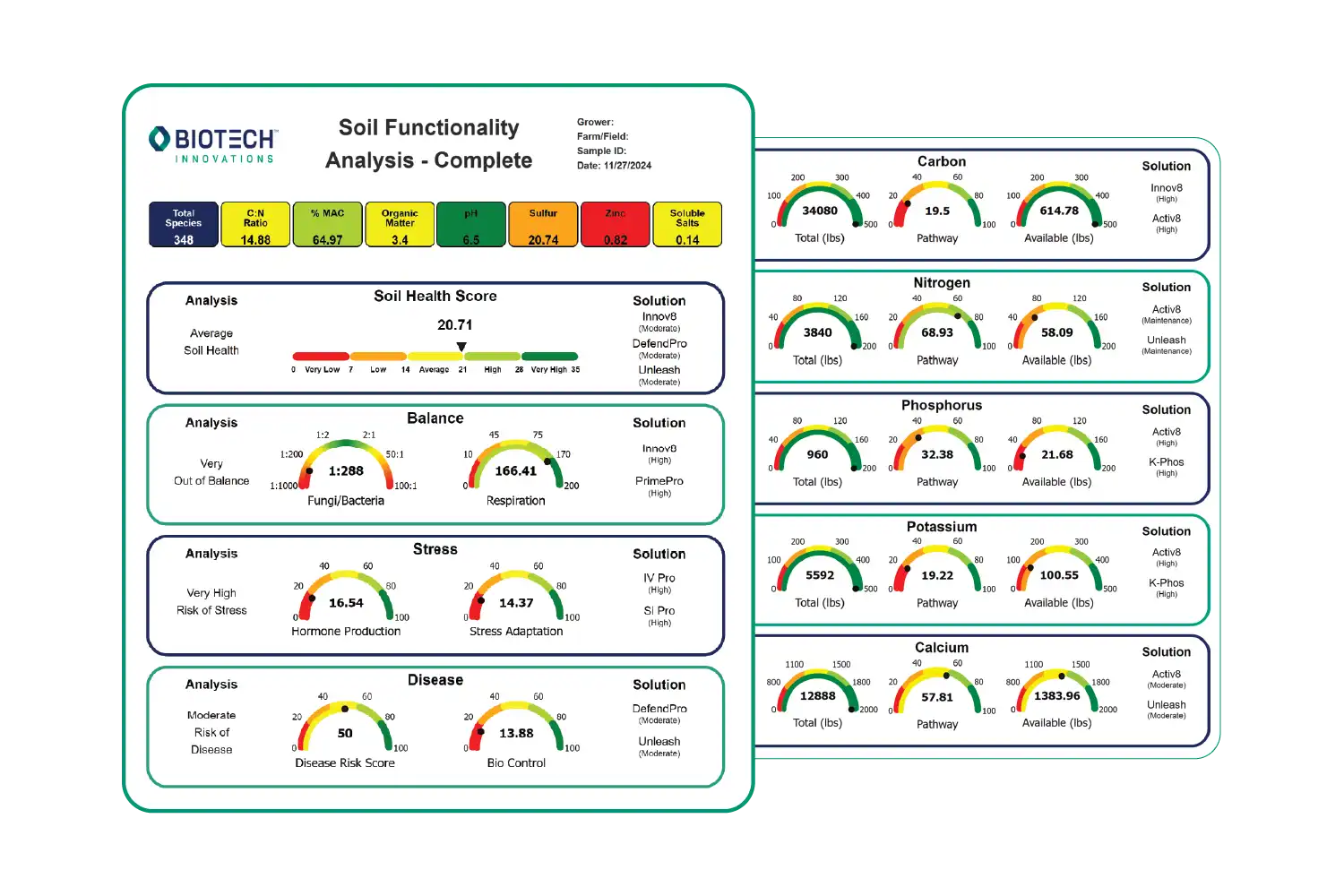
For the Soil Functionality Analysis (SFA) report, a soil sample is wetted and the amount of carbon dioxide released over a 24-hour period is measured. The more active the biological community is in consuming the available carbon, the more respiration the test can detect.
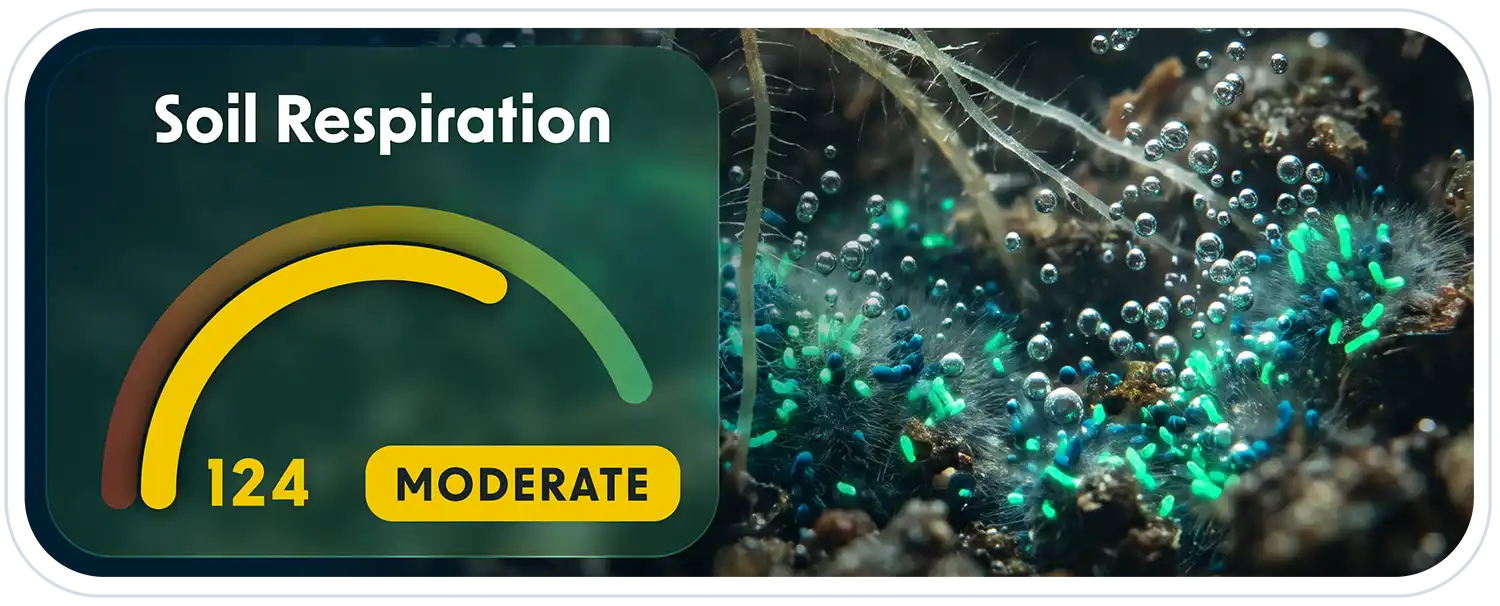
In other words, respiration offers an important clue about the activity level of the microbes in your soil. The ground beneath your feet will contain microorganisms, but simply having them present doesn’t mean that they’re actively performing the work your plants need to produce a profitable crop.
At Biotech Innovations, this one of the questions we're trying to answer:
Is your soil biology working for you?
Why should you care how well or how much the microorganisms in your soil are breathing? Because those microorganisms have important work to do.
Healthy soil biology helps:
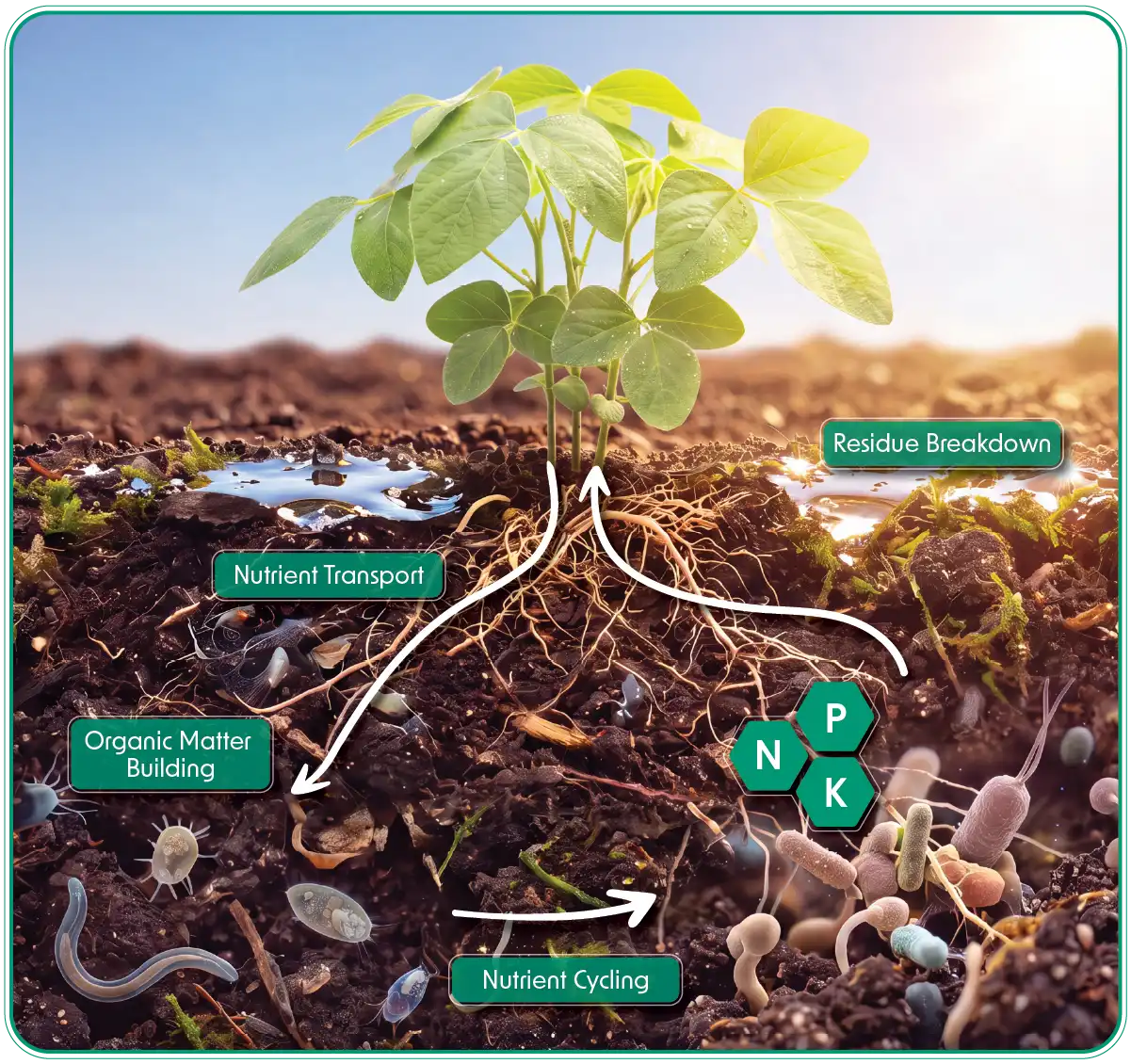
Just as you can’t work effectively all day without food, microorganisms require energy to do their jobs. At Biotech Innovations, we view microbially active carbon, largely carbohydrates, as the food supplying that energy. As microorganisms consume that food and perform their work, respiration provides the evidence that the process is taking place.
Every measurement or section on our SFA report is intentional, which goes for respiration as well. It’s not science for the sake of academics—it’s science that provides real-world impact for your farm.
Respiration and carbon are closely connected. Your soil contains different forms of carbon, but not all of them are immediately useful to microorganisms. Some carbon is mineralized and relatively unavailable to biology. Other carbon is water-extractable, or soluble, and can become an active food source for microorganisms.
The SFA report measures this available carbon and compares it with respiration to help determine how much of that carbon is actually being utilized by the biological community. That relationship matters.
A soil may contain plenty of total carbon but have relatively little carbon available to feed microorganisms. Another field may have available carbon present but lack the biological populations needed to make efficient use of it. In either scenario, the soil biology’s functions may be impaired.
When enough available carbon and an active biological community come together, respiration increases. At this point, the soil is no longer simply storing carbon—the biological “workforce” is consuming it and then using that energy to perform the important functions your crop needs.
Let’s say you receive your SFA report from your Biotech Innovations dealer and you notice a low respiration number. This number alone doesn’t explain what’s wrong with your soil. Instead, it tells us where to begin asking questions. Your Biotech Innovations dealer will examine your entire report to get a picture of what factors are impacting your soil’s health and where there are opportunities for (literal) growth. These might include:
Our goal isn’t to simply boost your soil respiration number or any single number on the report, for that matter. Our goal, and the goal that matters most for your farm, is ultimately to restore the functions that the respiration number represent.
Located in the same section of the SFA report, the fungi-to-bacteria ratio provides an especially important piece of the respiration story. Biotech Innovations commonly sees agricultural soils that are heavily dominated by bacteria and have compromised fungal populations. In the SFA Report, that imbalance often corresponds with lower respiration.
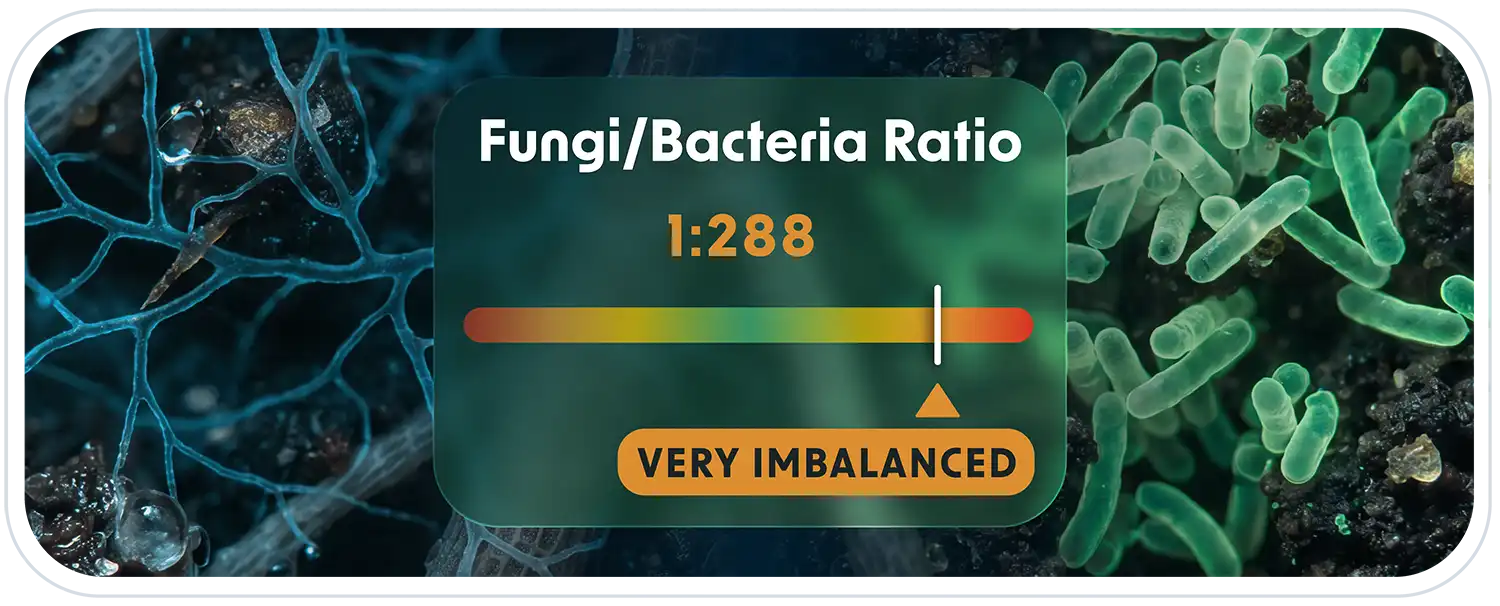
When fungi and bacteria move toward a healthier balance, we generally see respiration increase. Fungi require energy to maintain their colonies and networks, and active fungal communities contribute substantially to the carbon cycling taking place in the soil.
This is why simply knowing that microorganisms are present isn’t enough. Again, our goal is to look at the complete picture and answer several interconnected questions:
If this is the first of our Knowledge Center articles you’ve landed on, welcome! Before you surf off to your next website, you’ll want to check out a few more of our articles on the other SFA report measurements. You’ll soon discover that everything in the SFA report and in your soil is interconnected.
In relation to respiration, total carbon tells us about the larger carbon pool in your soil. Available carbon tells us how much carbon has moved into a form that can potentially participate in biological processes. Microbially active carbon helps identify the portion serving as food for soil biology.
Respiration gives us another piece of information: Are the organisms actually using it? In this way, you can think of the SFA report as a chain of measurements
That’s why you shouldn't evaluate respiration or any other SFA measurement in isolation. Consider two fields with similar available-carbon levels. One has strong fungal populations, active bacteria, and high respiration. The other has compromised fungal colonies and low respiration.
The food may be there in both fields. But the biological workforce between the two won’t be able to do the same amount of work.
So your SFA report results are in. Now what? We don’t want to just make your soil release more CO₂. The goal is to improve biological activity in your soil, which in simple terms means more workers working more vigorously together to perform the processes that benefit your crops.
As biological activity improves, the organisms in your soil have more energy to solubilize and cycle nutrients. That can improve the availability of nitrogen, phosphorus, potassium, and other nutrients already present in your soil or supplied through your fertility program. You’ve already spent a lot of money to apply fertilizer; it makes sense to capitalize on that investment as much as possible.
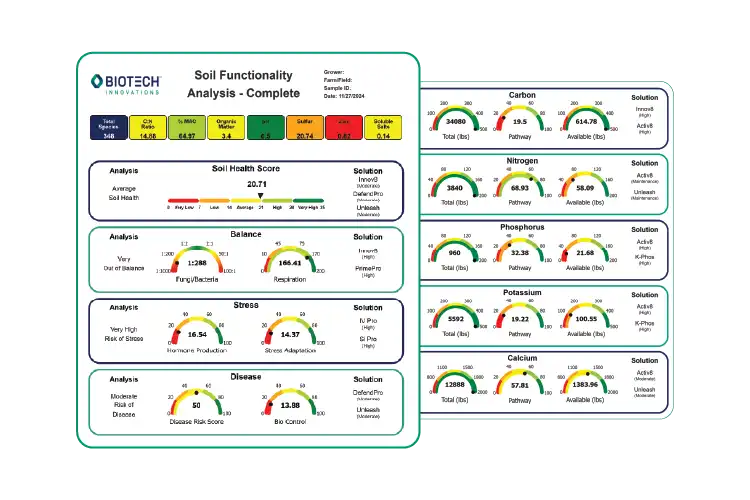
A traditional soil test will measure the amount of nutrients in your field. An SFA report helps your Biotech Innovations dealer evaluate the biological system responsible for putting those nutrients to work.
Respiration is one important part of that evaluation. At Biotech Innovations, we look at respiration alongside measurements such as:
Together, these measurements help us identify where the biological system may be compromised and what may be limiting nutrient cycling in your field.
Read More: Carbon: The Foundation of Soil Function
Read More: How A Healthy Carbon-to-Nitrogen Ratio Helps Your Soil Release More Nitrogen
A community of microorganisms in your soil isn’t enough. This community needs to be balanced, have access to the right food sources, and have an environment that allows them to actively perform the jobs your crop depends on.
Soil respiration gives us a window into that activity. A complimentary Soil Functionality Analysis report from your Biotech Innovations dealer can help determine whether your soil biology is actively cycling carbon and nutrients, or whether something in the system is limiting its performance.
From there, your dealer can develop a strategy to support the organisms and pathways your soil needs to help you get more from your fertility investment and Unlock the Power in Your Soil.